icon-dot-gov icon-https Locked padlock icon
USA Flag
An official website of the United States government. Close/span>

1834-1839

Classic Head Eagles

William Kneass succeeded Robert Scot in 1824 as the principal engraver for the Mint. In 1834, he sculpted the Classic Head Eagle (1834-1839). The Classic Head was a departure from the earlier Scot/Reich designs by showing Liberty wearing a headband with uncovered curly hair, as opposed to the capped Liberty design.

The debut of this coin coincided with a Public Law that reduced the weight of gold coins.

Due to the rising price of gold during this period, most gold coins were exported and melted, making early eagles rare collector items today.

Philadelphia Mint background

1838-1908

Liberty Head Eagles

The Liberty Head replaced the Classic Head design on the gold eagle in 1838, the half eagle in 1839, and the quarter eagle in 1840.

Mint Engraver Christian Gobrecht's obverse design portrayed a left-facing Liberty with her hair pulled back, wearing a coronet. The reverse showed a modified version of the Classic Head design with an eagle clutching arrows and an olive branch.

Gobrecht's Liberty Head saw one of the most impressive production runs in the history of circulating coins. The half eagle and eagle were modified slightly in 1866 with the addition of the motto "IN GOD WE TRUST" on the reverse.

The quarter eagle, however, was minted without any changes for 67 years (1840-1907).

1907-1933

Saint-Gaudens Double Eagle

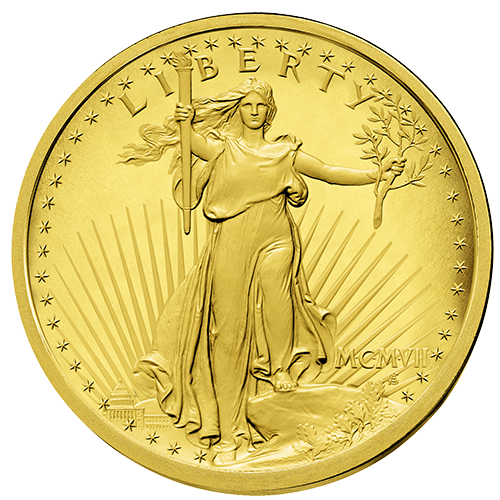
The collaboration between President Roosevelt and Augustus Saint-Gaudens ultimately resulted in what has been called the most beautiful coin ever minted in the U.S. and perhaps the world: the 1907 $20 gold coin, also known as the Double Eagle.

This design underscores that liberty is central to the American spirit. Wherever Liberty goes, so does enlightenment, and peace follows.

On the obverse, Saint-Gaudens shows Liberty, personified by a statuesque woman striding powerfully forward. Liberty’s robe harkens back to our roots as a republic based on the ideals of ancient Greece and Rome. Liberty is leading the way with a torch in her front hand and an olive branch in the back hand.

The U.S. Capitol is depicted in the background, meaning that through representative democracy, Liberty has been fully achieved in America, strengthening her position to go throughout the world.